
It so happened that “Footprints on the Road” is the first book in the Ukrainian language I bought in my life. This is the first book in Ukrainian I wanted to buy and finally my “dream” came true.
We live in interesting times. On February 1st I place an order on the website, on February 2nd the book is sent to me, on the 3rd I receive the parcel, and on the 4th I already start writing a book review, because it was read as the first of the three ordered books.
For some, such dexterity may mean the flavor of an enthusiastic review of the book “Footprints on the Road”, but take your time, gentlemen. Let me tell sequentially.
For me, Valerii Markus is foremost a blogger, and only then he could be perceived as a writer and a military man. On this page, all his “regalia” are put aside, I am writing a review exclusively for the work of art, the novel “Footprints on the Road”, that is how the author calls it in one of promos.
The phenomenon of the book “Footprints on the Road”
There are quite a lot of positive reviews, the absolute majority of them. Of course, this bribes, but it is also a little confusing, because I often saw a similar picture on the sites of infogypsies, whose activities I learned a lot.
The phenomenon of the book consists in the fact that it cannot be bad a priori, because it is bought as an addition to an already formed positive attitude towards Valerii as a media person, as a blogger or a military. And the positive reviews developed in due time do their job at a distance and attract buyers with their approval.
Am I a victim of this marketing? Of course. Like everyone else who sympathizes with Markus.
The book was bought and read not so much because it has a certain positive resonance in the media and thus calls out – “read me, I’m beautiful!”, but rather as an additional source of information that I should use to form a more complete portrait of the author in real life.
Positive moments
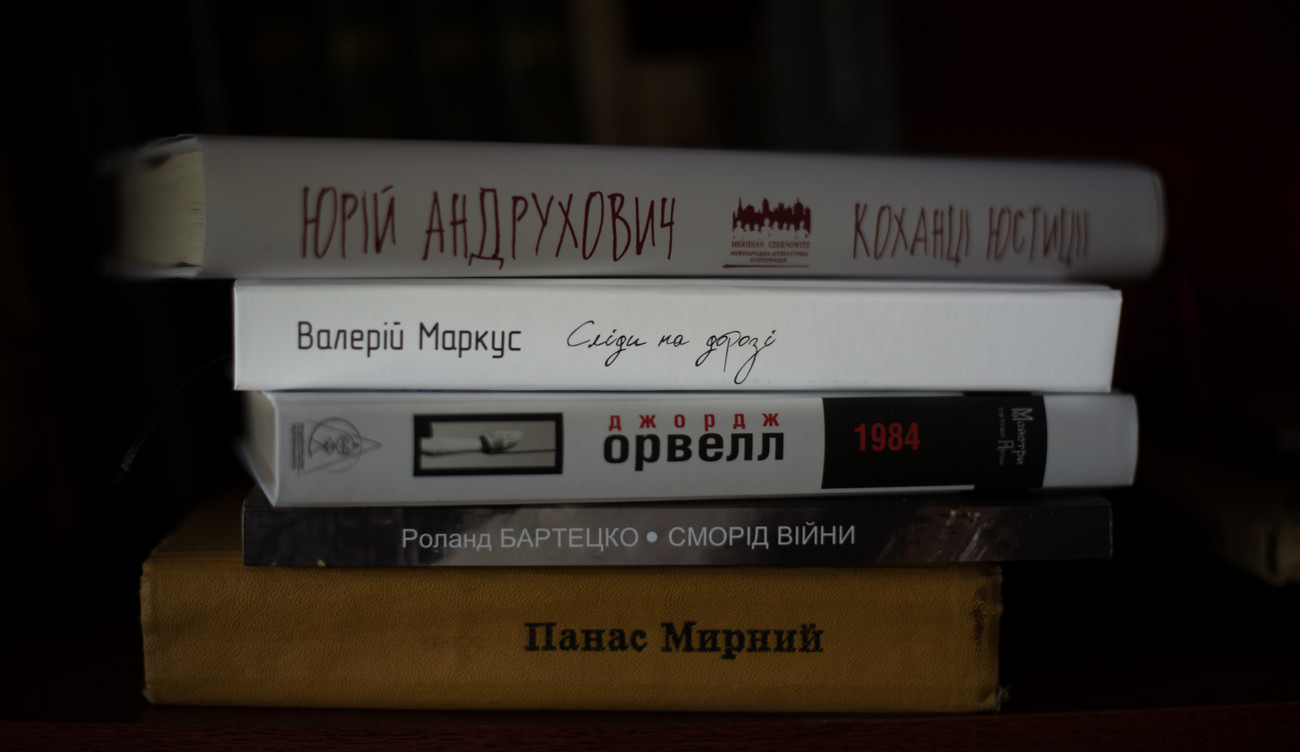
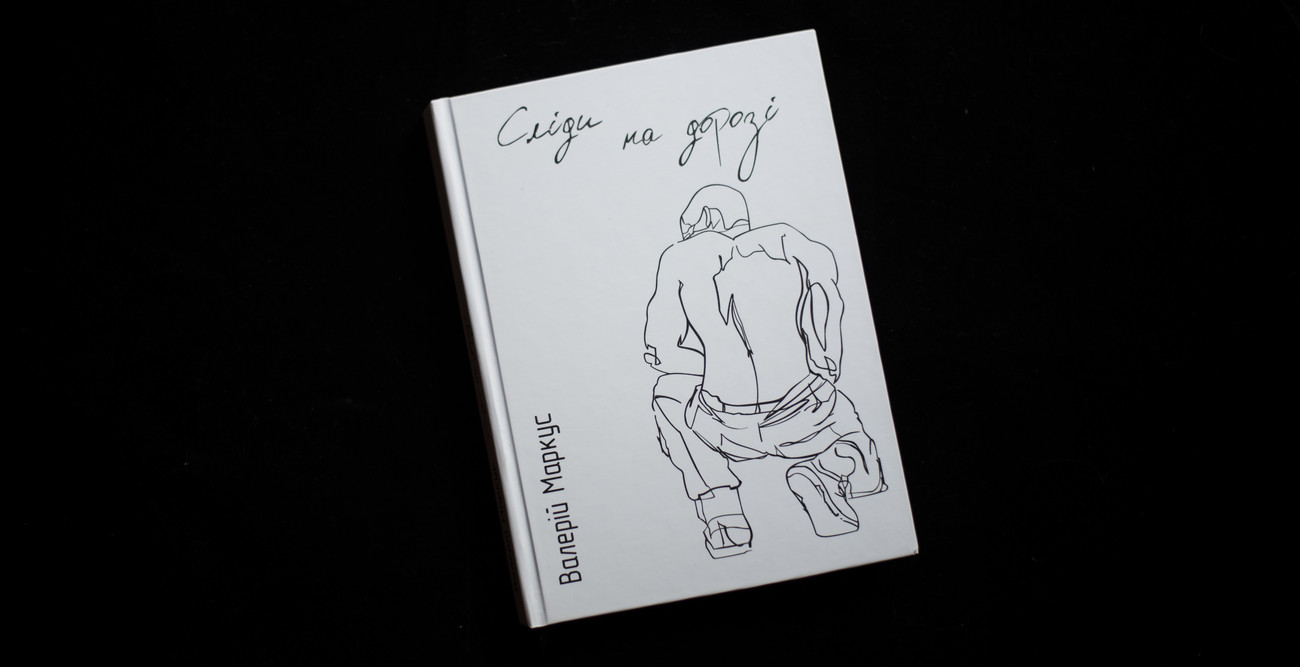
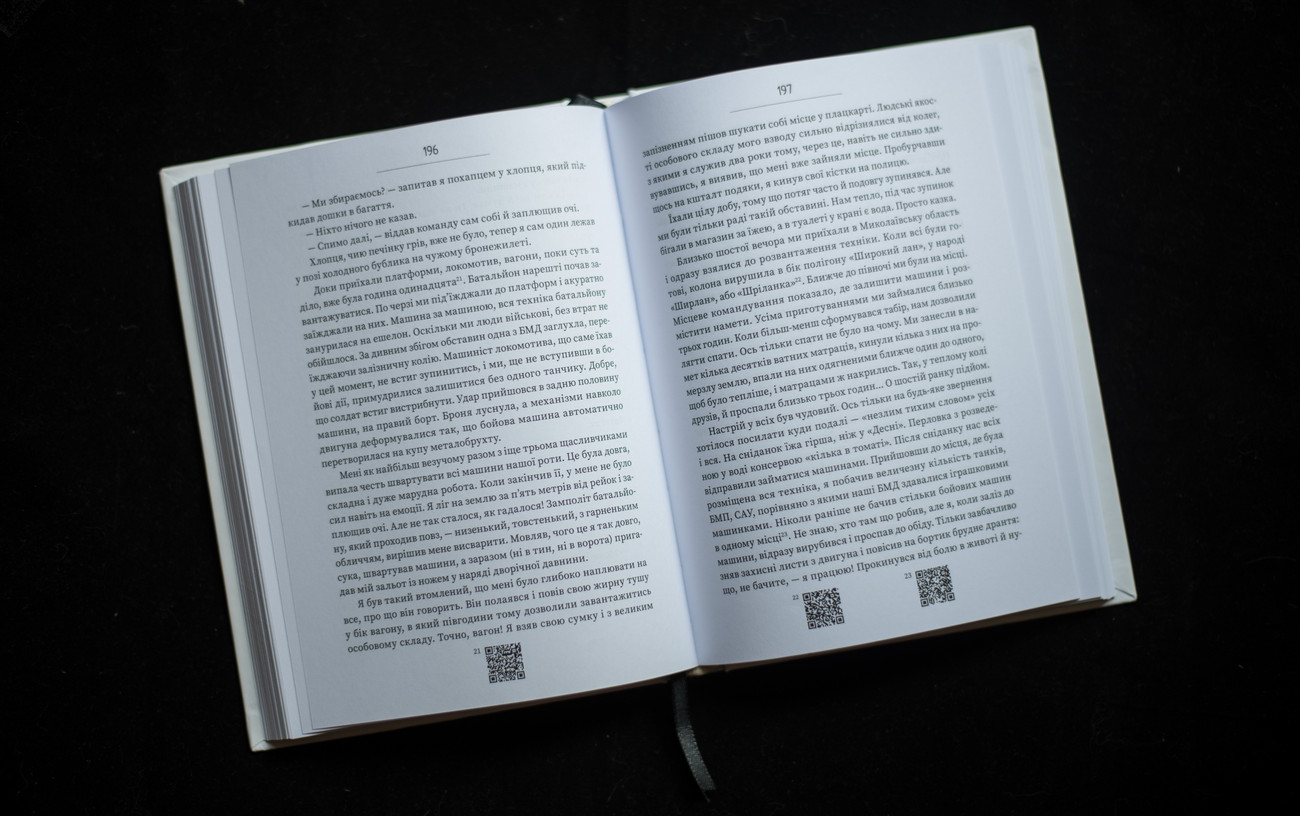
Design, typography, bookmark – all these are indisputable pluses that significantly bring you closer to the book, make the reading process pleasant and comfortable.
White paper and sketches work as contrasts to the events taking place. The work plays with these contrasts.
I consider the decision to surround reader with light colors and depict the darkness inside to be the most successful in this book.
I was pleasantly surprised by the capitalization of family members (Mother, Uncle, Dad, Grandma, Grandfather, etc.). I see this technique for the first time, and it attracts with its warmth and eloquently conveys respect for all these people without unnecessary words.
The solution with QR codes is controversial, but I will still add it to the pluses, because it was the first such experience for me. Overall, it’s distracting from reading, and there were a few times when I didn’t have a mobile connection to view the media I wanted. I personally prefer a self-portrait (in my head). This technological decision makes the book less attractive from an artistic point of view, it is increasingly perceived as a documentary chronicle.
The very fact the book was written and published in-house was already a positive signal for me and is a separate plus.
I was interested to learn more about the author, because the media profile, as I wrote at the beginning, is quite attractive, especially from the point of view of qualitative changes.
The book, written by a soldier after the warfare, somehow deserves attention and is a positive event in the Ukrainian literary space.
The style (if you can call it like that) is quite easy to sense. Markus feels quite comfortable in the role of the narrator, and he succeeds in it, even though the original text is written in russian, and the translator to Ukrainian put his hand (style) to the novel later.
“Each new life experience transforms the world, and we see it differently.”

Cons of the book “Footprints on the Road”
I can’t say cons word fully justifies its mean in the case. Rather, these are details that distance my perception of this book from one I would give the highest score and be delighted with (which is exactly how I hoped to feel after reading it).
Below, I’ll talk about things in pile are removing “Footprints on the Road” from my favorites and must read category.
Hero-author
Sympathy for the main hero is formed on the basis of my knowledge about author (Valerii Markus). Let us imagine I am just reading this book, then the boy depicted in it at the beginning does not really like me. This is just an ordinary Ukrainian boy from a typical family, who talks about himself 15 years later.
Did the closeness arise from nostalgic parallels from my childhood? No, because everything was different for me.
Did I like this indifferent, aggressive, uncaring little guy? Absolutely not. But I can’t get my attitude towards the author out of my head, because the book doesn’t allow me to do it with its categorical autobiographical subtext.
This repetitive juxtaposition, comparison, analogies, drawing of a real person with main character and vice versa is an interesting experience, but it does not allow me to fully concentrate on the plot as such and see it more objectively. But all biographical works have that flaw, although the author denies its documentary essence and calls it a “fictional novel.”
And I honestly tried to read it as a novel, as a work of art, and I couldn’t at all.

Contradictions in the book “Footprints on the Road” (caution, possible spoilers)
They are barely noticeable and may seem controversial, especially for those who do not pay attention to details, but are fascinated by the story or other elements of the work.
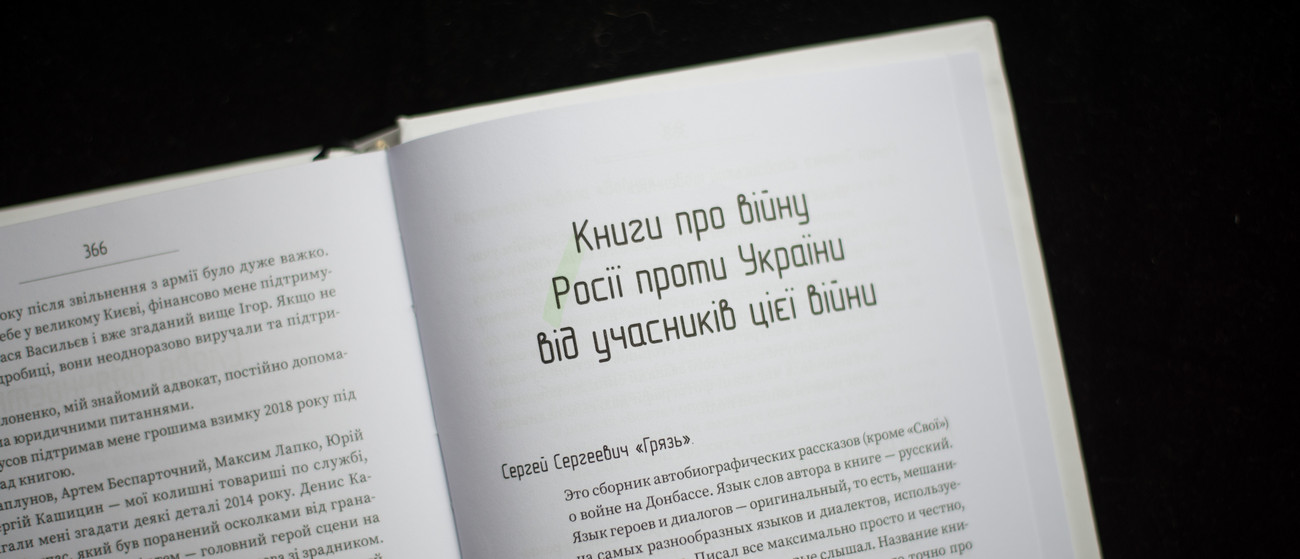
- In the text, russia is mentioned once (or several times) and this word is written with a lower case. At the end of the book there is a list of books under the heading “Books about the war between russia and Ukraine…” where the name of this country is capitalized for some reason.
- Towards the end of the novel, we read, “for some reason I did not feel any pity in such situations. I had an understanding it was terrible. But I felt absolutely no emotions.”
All would be fine, but 15 pages later the author writes, “I didn’t feel anything while killing, but the death of well-known people hurt.”
It seems that everything is logical and can be understood, but there is absolutely no “distance” between parts, too little time has passed, too few events have happened for the hero to somehow radically change his attitude towards death, which he was watching nearby. This was the beginning of my disappointment, which lasted until the very end.
I could not understand in any way, so he still hurts or does not care? I was never able to answer this question. - At the end (and also at the beginning) of the book, the culminating episode – which “encouraged” to read full text and find out, after all, what happened there, why he did it – contradicts the logic and the state of the main character. He (the main guy) is doing well, life is getting better, he has very clear and optimistic plans for his future, everything is great, and suddenly… for some reason, he decides to put a bullet in his head.
- I will also add the uncertainty of style (genre) to the contradictions. Documentary, chronology, QR-codes with videos and photos, the reference of Markus himself in the comments to the book that some people from it really exist and are alive to this day — all this makes the novel exclusively autobiographical. But the artistic component, which is existing in several moments, destroys this feeling, destroys trust, doubts arise about the veracity and a completely logical question come up – “whether everything was told is true?” Could the author have invented something to embellish the plot, because this is not a fully documentary chronicle, but also a work of art?”.
- Bribes cases. At one point, the hero agrees to the terms of the leadership (with a bribe), then immediately writes this is the last time. A little later, he gave bribes and offered himself. Then he refuses again when he wants two extra days of vacation, then immediately curses at restless people who will not calm down with their bureaucracy. The main hero is thrown from one end to another. So how to perceive it? As actual disorders with the head, or as unfinished text?
- Books and reading. The love of literature is not suit to the schoolboy he described. I don’t know how it really was, but the guy in “Footprints on the Road” is an outright badboy. Books and the desire to learn, study the world in general is not related to the image. This significant (evolutionary) step is not explained in any way, causing completely logical questions from reader.
“The army reveals a person very quickly. All the rottenness it has inside comes out, so clearly it starts to stink. There is just too much shit around, one shit doesn’t notice the other and thinks this stench around is a normal thing.”

Documentary/fiction
I will write about this a little more in a separate subheading, because this is the main problem of this book. Two states of the work (documentary/artistic) constantly argue with each other. The novel is vaguely oriented.
Artistry implies a certain logical attractiveness of events, the plot, the development of the hero. In an art book, you can give free rein to your imagination, invent something, lie somewhere, embellish, etc.
Biographicalism prepares facts like “everything is as it is”, just write as it was and don’t lie. But in the work there are certain troubles with decisions, with logic, with events description.
It also contributed to the superficial portrayal of additional characters. None of them evoke deep sympathy, although some have received a lot of attention (text). Actually, this problem should ideally be solved by the author even in a documentary format, adding certain data, words, additional episodes to a specific minor character. What we have here: came-entered-stayed-died-(survived). No emotions (for me).
QR documentation
The process of independently deciding what exactly is happening and how is proposed to be replaced with audio and video fragments. On the one hand, this is a great decision, but… The book thus once again emphasizes the documentary component, and further leads us away from understanding the text as an artistic one.
Words, events, decisions – everything seems to have happened in reality, but the author himself says: this is a novel, this is a work of art; and who knows how much truth is in it, and how many fictional episodes.
One of the clear conflicts with these codes occurred at the moment when, according to the text, the guy seems to be experiencing winter, and the photo provided by the link showed him in a warm season (spring or summer).
Love line
Personally, I lacked frankness in the love-romantic section. This fragment strongly affected my perception of the hero, because I realized the sector, I consider essential in the formation of a person, is simply ignored in the plot. The author himself directly writes, “this is my personal matter, I will keep quiet about it.” Well, then why was there any mention at all about girls, about the first meeting, about visiting, etc. The girl simply disappears because the author wanted it that way.
The love scenes could also be more expressive, but…

Development of the hero
It was not enough to reveal the topic of becoming and growing up. The emphasis was placed on events, not on inner experiences. This period of constant waiting continues until the middle of the book, when the War begins. We never found out what drove the hero. He simply existed.
Intrigue, conflict in Footprints on the Road
The overall picture of the conflict seemed quite aggressive to me. The intense fragment drawn at the beginning emphasizes the fact that “the book must be read to the end, because you’re wondering why I want to blow my own brains out?”
And this compulsion confused me a little. The documentary nature of the story does not allow for such artistic moves, and the ending of the work proves it once again.
If we ignore the “edge” that the main character seems to have reached at the beginning (at the end of the book), then the work is completely devoid of intrigue. Everyone knows that Valerii is alive and well (at least at the time of writing the book and this review), what could happen? Actually, nothing!
The first half is frankly long and if it weren’t for my desire to just read the book and my interest in the author himself, I might have given up reading at this point.
The lack of conflict as such in the plot (and its documentary part) pushes the author to artistic techniques, which he implements extremely unsuccessfully. I would gladly forget the beginning and the end and throw it out of my head, but I can’t. They demolish the work, make it less attractive in my eyes, and in general significantly conflict with the documentary character.
“There is nothing more difficult than winter in the army”
Question
Too many questions remain unanswered. It’s not bad, but against the background of general hypocrisy and indifference of the main character, something is pulled by the ears, as if to give more value to the text. The words that sound at the end of the book do not resonate with person who appears in the photo, the video of those times.
Philosophical insertions are noticeably later in maturity and were evidently formed much after the events that took place in the book. This technical shortcoming could be corrected with good plot and artistic solutions, but the documentary work’s soul does not allow much maneuvering.

Additional piece of paper
Along with the book, there was a small separate piece of paper with the text. There was something written about the book, but I remembered one interesting thing. Valerii encourages people to write book reviews on social networks and websites, and at the same time says “best of them will be published in the next edition”.
I immediately became curious: how likely is it among reviews there will be conditionally negative, reasoned non-positive reviews, such as mine? Of course, the odds are headed to zero. Valerii, according to my observations, very aggressively accepts any criticism in his direction.
In one of his videos, Markus talked about verbal battles with one writer and that he did not provide a full-fledged criticism of the work, but only scattered general phrases.
My review is full-fledged, it is as well-argued as possible and not the kind that writers dream of for their works (vomiting-to-the-sickness-sweet-best-book-I-advise-everyone-to-buy-a-friend-on-birthday).
Most importantly, it is honest and subjectively oriented. But I honestly don’t care, because with act of verbal gush I am primarily practicing writing and blogging, helping people to see one more opinion of the reader, rather than “dreaming” of some kind of attention and recognition from the author.
In general, I was a little funny about this piece of paper, because it is one of many bricks the marketing house is built from, where Valerii’s creativity lives in, both as a blogger and as a writer. He is really one of the best at it.
Indifference in “Footprints on the Road”
This word shines as central throughout the entire work. The concept forms main character, it surrounds him from all sides. Several times he directly states that he does not care.
In the early years – he does not care to study, he does not care to communicate with peers, in the army – he does not care to choose a clearly defined position and to politics, in the war period he does not care to sacrifices, at the end of the book – he does not care to your whole life.
He thus ends his journey as an indifferent, indeterminate amorphous body simply performs a certain set of actions, because that is how his path and circumstances have developed.
This indifference can be traced in real life in relation to the reader. This is exactly how I perceive aggressive marketing, which is offered as a promo and advertising of the work.
Why? Because Valerii Markus embellishes the book too much by talking about it. He gives features that are not characteristic of this book, he deliberately sells the work, starting from the achievements he has as a media personality. He clearly understands (understood during the period of active promotion) the audience will buy it not because it is a great book, but because Markus himself is interesting and attractive as an author and a person, and advertising makes this choice (or rather lack thereof) decisive.
In other words, if you like Valerii Markus as a person, most likely you will want to read the book “Footprints on the Road”. It does not matter what the reason will be, but the fact of purchase or reading will be carried out.
This is exactly what I see as indifference to the end user, because in this way the author (as a writer one) does not get a qualitative understanding of how good his work is. Everyone who is delighted – congratulations, those who did not like it – “you did not understand the content and the message, you are just haters.”
Indifference is – the reader has no choice: you just have to like it. And most often I really like it, because the vast majority of readers sympathize with Valerii as a blogger, as a soldier, as a Ukrainian, as a person, and not as a writer.
The book acts not so much as an independent full-fledged perfect work that deserves literary heritage and attention, but rather as an additional source, a unique way to get to know this person, to get to know him more closely.

Editing in “Footprints on the Road”
This book lacked a quality editor. It shines with a Facebook style, the stiltedness of the stories, the lack of expressive artistic (documentary) style. All the shortcomings I mention in this review could be corrected by an adequate, experienced editor, a person who knows about it. Editor would have done everything much better than me and would have found a lot more things to complain about (read – make the book better).
It does not make work worse, because it is successful. But success is the result of complex personal brand development and full-fledged, frankly aggressive promotion.
Valerii did a lot in the media space for this book to be purchased by an audience loyal to him. But as a work of art, as a literary asset, it is weak.
The financial success of this project and the lack of equally enthusiastic full literary critics reviews speak for themselves.
A good editor could leave a footprint in the history of Ukrainian literature with this novel, but the footprints are only on the road.
Aftertaste of the book “Footprints on the Road”
Unpleasant. I started writing the review immediately, but finished it only two weeks after reading the book. So, what will I remember from it? 2-3 interestingly told moments and a terrible beginning-end, the so-called artistic component.
That is All.
I can’t get out of my head the fact I was actually cheated, I feel like that.
An unpleasant aftertaste borders on and coexists with disappointment.
I read the book quickly, but very attentively.
The book seems to be communicating, but keeps silent for a large part.
The novel seems to be frank, but also chooses words to make the right impression.
The aftertaste of a marketing victim. If (instead of eloquent appeals, you must read this fiction novel, it is so wonderful and bright) I was told honestly “these are the chronicles of a soldier who managed to survive in terrible times and not lose his humanity; the artistic component here is minimal, so don’t expect a raging exciting plot from it”, I would know what I am buying and how to perceive this work. But now I am saddened by this undisguised advertising promotion that has led to a depressed state.
Will I buy Marcus’ next book?
I know he is working on the next book, he has said it more than once in his interviews. It is quite logical that marketing will be built precisely on the success of that (first) book and the ever-growing personal brand. It exactly scares me.
The situation is a person who has reached similar heights in the media space, who has gained a certain number of followers who really appreciate his work as an author, can write anything, and it will have success, circulation and favorable reviews.
I don’t even know how frankly awful Valerii Markus’s next book has to be for “tomato-thrown” situation? This is practically impossible.
In the current realities, he is a self-sufficient person outside the writing space. He successfully serves in the defense of Ukraine, his position on many important issues finds an echo in the hearts of a wide range of adequate population, he is trusted and listened to, he is respected above all as a person and a citizen of our country.
Considering this, the purchase and reading of the next work will be a big question for me personally. Everything will depend on my mood. I am not one of those who will buy everything in a row “because I really like author”. I buy and read only what I consider potentially useful and interesting.
For now, I don’t want to buy “second book”, but I will be able to support the Ukrainian author, the Ukrainian literary and publishing market. If Valerii does not draw conclusions and goes down the same road, making the same footprints on the road, it will be the second disappointment for me. And perhaps not only as a writer.
Whom I recommend reading “Footprints on the Road”
This book is not for everyone. I say it as a person who was partially disappointed in her.
I recommend the book “Footprints on the Road” to those who:
- wants to get acquainted with the Ukrainian army of the 2010s;
- wants to see what and how a person with secondary education can write;
- wants to know a little more about the military conflict in 2014 from the Ukrainian side firsthand;
- already knows something about Valerii Markus and continues to be interested in him; this book will be an additional source of information.
“I clearly distinguished between the concepts of “man” and “military”. Because these are two completely different forms of life.”
Whom I do not advise to read “Footprints on the Road”
Who completely unfamiliar with Valerii Markus, this book may be bland and boring. Especially its first half of text.
I do not recommend this book to those for whom the documentary chronicle is less attractive than the artistic style of the story. It is not a work of fiction, it is not a novel, it is just a chronological drama. It almost completely lacks an artistic component. This is a story from the first person, an autobiographical documentary chronicle with photo and video accompaniment.
Conclusions
Positive moments
Great design, bookmark, high-quality paper and binding, no errors in the text, an original solution with QR-codes (although I’m still in favor of creating an image in my own head without any help).
I would like to single out as a positive point the list of other books about the war at the end. I found some interesting works there I will read in the near future.
Negative components of the book “Footprints on the Road” by Valerii Markus
Especially in me, the book did not evoke bright emotions that are characteristic of high-quality and powerful works. There are many important topics covered here, but it is done in a rather primitive style. Dominant documentaries killed the magic of artistic disclosure and the main character, and all accompanying components.
The translation from russian is noticeable. Although the text is of high quality, there are no obvious mistakes, but there is also no melodiousness, singing of Ukrainian, which can only be in a native speaker and only in his native language. In other words, “Footprints on the Road” is even more interesting to read in russian (this is not an encouragement, it’s just a fact). The next book, I am sure, will be in Ukrainian. And there Markus will be able to prove my thesis with deeds (and words).
The clumsy rhythm of the story, several blunders and white spots, the terrible ending in terms of style and logic, the first half of the book is too long, the lack of character development (as a result of the autobiographical format), the lack of disclosure of the characters, contradictions – all of it does not allow me to give this book a high rating and call it a worthy copy in my library.
As one of the indicators of the quality and value of the work, I consider the desire to return to reading it: either immediately (up to certain moments), or later, to once again enjoy the course of events, individual phrases, characters, etc.
“Footprints on the road” do not cause such a desire. There is nothing in this book I want to go back to. Especially for me, it seemed superficial, overrated and empty.
This does not automatically make her bad, because this is all a subjective phenomenon, I express my own opinion, which has its individual components and reasoned criticism.
As an event in the Ukrainian space, as art therapy for a military man, as one of the steps on the ladder of self-development – this is an outstanding book that deserves attention and a certain respect in a general sense.
But the feedback is candid in the literary space, specifically about the literary work, which in its ideal perception is not tied to the author and his successes in real life. The autobiographical nature of the book prevents this. Even with great desire, I will not be able to perceive this novel differently, because everything has already happened.
I read the book, I know enough about Valerii Markus, enough time has passed since reading it to speak calmly and soberly. Perhaps I am wrongly making such a division, but I am honest with myself and cannot change my attitude towards the work with a wave of my hand. I honestly asked myself the question, “what exactly I did not like?”. After a few days, I found the answer and left thoughts in this review.
As an independent literary work, it is weak. This book rests on successful marketing, on a personal brand that Valerii worked on for many years, and on a unique component of any work about war. As an autobiographical note and the materialized result of a certain stage of Valerii’s life, it is an excellent example of how it should be done.
My final assessment consists of thanks for the additional information about military life, about 3 interestingly presented moments in the book (I wish it was all sprinkled with them), about quality typography and design. Before reading, I was waiting for 9 or even 10 points, but:
My rating for the book “Footprints on the Road” 6 out of 10


This review lacked a quality editor. Especially for me, it seemed superficial, overrated, and empty.